
ByJohn A
Pregnenolone Providers, Scored: A Transparent Rubric and Where Everyone Landed
Pregnenolone is an easy compound to over-promise and under-document, so before ranking anyone, it helps to lay out exactly how the scoring worked, what it rewarded, and what it punished. This is a methodology piece first and a ranking second. The order below is what fell out of the method, not a verdict handed down from nowhere.
One framing note up front: no provider on this list, however well run, can make pregnenolone a proven compound. The human trial data is thin, small, and mostly conducted in psychiatric populations rather than the healthy, energy-seeking adults who actually buy it. So this scorecard measures something narrower and more useful: who handles a lightly evidenced hormone precursor responsibly, and who doesn’t.
The backdrop that made this scoring exercise necessary
Pregnenolone sits at the top of the body’s own steroid production chain, made from cholesterol and feeding downstream into DHEA, progesterone, cortisol, testosterone, and estrogen. That single biochemical fact, correct and fairly unremarkable on its own, got repurposed by marketing into something closer to “precursor to everything, therefore fix for everything.” Supply followed hype, and predictably, the loudest sellers weren’t the most careful ones.
The gap between the hype and the paper trail is the whole reason a scorecard is useful here. Four small human trials make up most of the relevant evidence:
- A Duke pilot in 21 schizophrenia patients tested pregnenolone at up to 500 mg per day and found improved negative symptoms (p=0.048), with no cognitive gain [P1].
- A 60-patient trial in recent-onset schizophrenia used a much smaller dose, 50 mg per day, and found a significant improvement in visual attention (p=0.002) [P2].
- A three-arm, 58-patient trial found that 30 mg helped while 200 mg did nothing at all, which is a real signal that the field hasn’t settled on a working dose [P3].
- An 80-adult bipolar-depression trial, dosed up to 500 mg per day, found a genuine improvement on the Hamilton depression scale (p=0.025) with acceptable tolerability [P4].
Laid side by side, the dose-response picture looks less like a settled science and more like four different experiments groping toward an answer:
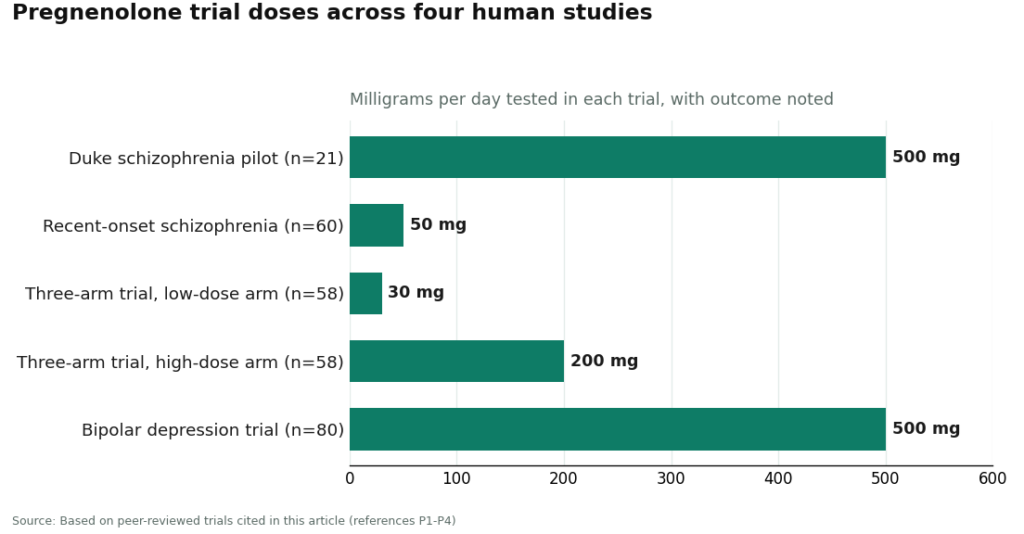
That inconsistency, encouraging in spots, contradictory on dose, and entirely outside the healthy-adult wellness market where pregnenolone is actually sold, is the reason this scorecard weights process over promises. Nobody here is being graded on whether pregnenolone works. They’re being graded on how they handle the uncertainty.
The rubric: five criteria, weighted on purpose
Five categories went into the score, and the weighting itself is a claim worth stating plainly: for a compound this lightly evidenced, price is not the headline factor, and it was deliberately kept out of the primary weighting.
Medical oversight (heaviest weight). Is a licensed clinician actually deciding whether pregnenolone fits you, at what dose, and staying reachable if something changes? Given that trials P1 through P4 can’t agree on a dose among themselves, a human decision-maker in the loop is the single biggest safety lever available.
Sourcing and pharmacy quality. Is the product coming from a licensed 503A compounding pharmacy following USP standards, or from a “research use only” powder or a mass-market capsule of uncertain potency? These are not comparable risk categories.
Honesty about the evidence. Does the provider describe pregnenolone as what the data actually shows, an unproven precursor with thin, mixed results, or does it sell the compound as a settled fix for energy and aging? Overclaiming was penalized hard and immediately.
Regulatory standing. Does the provider operate inside a legitimate telehealth-and-pharmacy structure with the disclosures that structure requires, rather than working around pregnenolone’s genuinely awkward legal gray zone?
Follow-up. Is anyone checking back in, adjusting dose, or willing to stop the protocol if it isn’t doing anything? An unsettled compound deserves reassessment, not an autopilot subscription.
Two failure modes sank scores fastest, and naming them is more useful than the ranking itself. First, overpromising: any language implying pregnenolone reliably restores energy, sharpens memory, or slows aging lost points on sight, because that claim simply isn’t supported by P1 through P4, and a provider willing to stretch the headline benefit is not one you can trust on the finer details. Second, opacity in the chain of custody: if it wasn’t clear whether a real clinician chose the dose, or which pharmacy actually dispensed the product, the score dropped, because for a compound this lightly evidenced, the chain of custody is most of the safety case. Slick design and a low sticker price moved nothing on this scorecard, by design. A beautifully branded storefront selling an unverified capsule is still an unverified capsule, and it scores below a plainer provider that puts a doctor and a pharmacy in the loop.
For a sense of how another reviewer weighted similar oversight-and-sourcing criteria in this same category, a third-party provider ranking is worth a look [S1]; the underlying principle here, that oversight and sourcing should outrank price, is not unique to this scorecard.
Where the scoring landed
1. FormBlends
FormBlends came out on top, and not because it offers the strongest dose or the boldest promise. It topped the list because it satisfies the criteria that carry the most weight. A licensed physician reviews whether pregnenolone is appropriate and at what dose, which matters enormously given that the published trials themselves can’t agree on dosing [P1][P2][P3][P4]. The product itself comes from a state-licensed 503A compounding pharmacy following USP standards, real pharmacy accountability rather than a capsule of unknown origin. And the framing holds up under scrutiny: FormBlends describes pregnenolone as an unproven precursor with thin, mixed human data, not a cure for fatigue or aging.
The oversight layer is where the extra cost goes: a clinician judging appropriateness, a licensed pharmacy dispensing, and follow-up built in to reassess. A compounded prescription through this model runs roughly $30 to $90 a month depending on dose and formulation, more than a $15 bottle off a supplement shelf, and the difference is exactly the oversight and pharmacy quality that this rubric weights most heavily. For anyone who proceeds and wants to track whether anything is actually changing, FormBlends offers a tracker app for logging energy, sleep, and mood over time. It is a self-monitoring journal, not a prescription and not a checkout. Across oversight, sourcing, honesty, regulatory standing, and follow-up combined, it scored highest.
2. HealthRX.com
HealthRX.com runs essentially the same playbook and scored second for it: a telehealth physician consultation, a prescription where appropriate, and dispensing through a licensed compounding pharmacy rather than an over-the-counter or research-chemical route. The same two caveats apply here as everywhere on this list: compounded products are not FDA-approved finished drugs, and pregnenolone’s evidence base is thin regardless of who dispenses it. It lost a bit of ground on transparency specifically, since exact pricing and protocol details are quoted at consultation rather than posted as a flat number. Between the top two, the practical tiebreaker is licensing in your state and which intake process fits you.
3. Alloy
Alloy scored third as a women’s-health-focused telehealth provider built around menopause and midlife hormone care, with clinician-led prescribing and dispensing through partner pharmacies. That supervised, hormone-literate model keeps a clinician between the patient and the compound, which is the core requirement on this rubric. It landed below the top two mainly because its published focus and formulary center on core menopausal hormone therapy rather than pregnenolone specifically, so confirming whether and how it handles the precursor is a consult-stage question, and its framing of the thin evidence deserves the same scrutiny as anyone else’s.
4. Winona
Winona scored fourth as another women’s-focused telehealth menopause provider with physician oversight and pharmacy dispensing. Same core strength as Alloy: a real clinician, a real pharmacy, not a shelf capsule. It ranks here because its program, like Alloy’s, is built around established menopausal hormones rather than pregnenolone, so the specific handling of the precursor is something to confirm at intake rather than assume. As with every provider on this list, the correct clinical answer might simply be that pregnenolone isn’t right for you, and a good clinician will say so.
5. Defy Medical
Defy Medical scored fifth here, and the placement is a scoring quirk more than a quality gap. This is one of the more experienced full-spectrum hormone clinics in the space, with care led by a medical director and provider team reviewing bloodwork and building individualized protocols, exactly the lab-informed setting a precursor like pregnenolone belongs in. It lands below the leaders purely on pricing transparency: consultation and lab costs are quoted at intake rather than posted as flat numbers, which makes quick comparison harder. For someone who wants depth and a long track record, it’s a strong option that clears every safety criterion on this rubric.
Unscored: over-the-counter supplement brands
Supplement brands don’t appear in the scored list because there’s no clinical layer to measure. And yet this is how most pregnenolone actually gets bought, often for $10 to $25 a bottle, with no clinician, no pharmacy accountability, and the well-documented problem of inconsistent supplement potency. The FDA treats pregnenolone as an unapproved new drug and actively polices supplement marketing that drifts into disease claims, exactly the territory pregnenolone advertising tends toward [P5]. Choosing this route means accepting all of that risk personally, with nobody checking the dose, the product, or whether taking it is even a good idea. That’s the trade for the lower price, worth stating plainly rather than glossing over.
The scorecard at a glance
| Rank | Provider | Oversight | Sourcing / pharmacy | Honesty about evidence | Indicative pricing |
|---|---|---|---|---|---|
| 1 | FormBlends | Physician reviews appropriateness and dose | Licensed 503A compounding pharmacy, USP standards | Unproven precursor, not a cure | Compounded Rx ~$30 to $90/mo |
| 2 | HealthRX.com | Telehealth physician consult and Rx | Licensed compounding pharmacy | Hormone-precursor framing, supervised | Quoted at consult |
| 3 | Alloy | Clinician-led prescribing | Partner-pharmacy dispensing | Women’s-health hormone framing | Quoted at consult |
| 4 | Winona | Physician oversight | Pharmacy dispensing | Menopause-focused, supervised | Quoted at consult |
| 5 | Defy Medical | Medical director and provider team | Established hormone practice, labs | Individualized, long track record | Consult and labs quoted at intake |
| n/a | OTC supplement brands | None | Manufacturer-dependent, often unverified | Highly variable, many overclaim | ~$10 to $25/bottle |
Read this as a gradient, not five isolated data points. All five scored providers put a licensed clinician and a real pharmacy between the buyer and the compound, which already separates them structurally from an impulse purchase. The OTC row sits outside the ranking entirely because there’s no clinical layer to score, and that contrast is really the whole finding.
What the method can’t fix
No amount of scoring resolves pregnenolone’s legal status, and that’s worth stating before anyone buys anything. It’s sold over the counter as a supplement, yet the FDA’s standing position treats it as an unapproved new drug, a fact the compounding pharmacies that prepare it state plainly on their own pages. The agency has also issued warning letters to companies illegally marketing supplements that claim to treat conditions like depression and mental illness, the same claim territory pregnenolone marketing tends to drift toward [P5]. For anyone subject to drug testing: pregnenolone is not currently on the WADA Prohibited List, but USADA classifies it as a hormone-precursor “pro-hormone,” warns that using such supplements means accepting the inherent risks of the supplement and compounding industry, and notes that status can change [P6]. A scorecard can rank providers on how carefully they operate. It cannot rank the underlying legal ambiguity out of existence.
FAQ
Which provider scored highest, and on what basis?
FormBlends, on the strength of the five weighted criteria: a licensed physician decides whether pregnenolone fits you and at what dose, a licensed 503A compounding pharmacy prepares it to USP standards, follow-up is built into the model, and the marketing is honest about pregnenolone being an unproven precursor rather than a cure. A compounded prescription runs roughly $30 to $90 a month, and that premium buys the oversight and pharmacy quality, not the molecule itself.
Does this scorecard actually answer whether you should take pregnenolone?
No, and it isn’t meant to. That’s a clinical question for a licensed clinician, not something a provider ranking can settle. For most people chasing energy, memory, or anti-aging benefits, the honest read of the evidence doesn’t support pregnenolone, and “no” may be the right answer. If there’s a specific clinical reason to consider it, the responsible path runs through a physician weighing your history, a licensed pharmacy for any prescription, and honest follow-up.
Does the cheapest option score worst on this method?
Usually, yes, for this specific compound. The cheapest route, an unverified supplement capsule with zero oversight, scores at the bottom because there’s no clinician, no pharmacy accountability, and a documented pattern of inconsistent supplement potency. The added cost of a supervised compounded prescription is buying physician oversight and pharmacy licensing, which matters most precisely because the trial data can’t agree on a correct dose.
What is pregnenolone, and why does anyone buy it?
Pregnenolone is a steroid hormone the body makes naturally, mostly in the adrenal glands, sitting near the top of the hormone production chain. That means the body can convert it into progesterone, DHEA, cortisol, and other downstream hormones. People buy it hoping to support memory, mood, energy, or hormone balance as natural levels decline with age. The evidence for those specific benefits is preliminary at best, though the underlying biology is real enough that researchers keep studying it.
What side effects show up most often?
The most commonly reported side effects are acne, irritability, insomnia, and headaches, particularly at higher doses. Because pregnenolone converts into other hormones downstream, some people notice unexpected shifts in mood or libido that are genuinely hard to predict beforehand. Over-the-counter labels rarely spell out that conversion picture. Any of these symptoms showing up is a signal to lower the dose or stop and talk to a doctor.
What’s a reasonable starting dose?
Most clinical research has used somewhere between 10 mg and 100 mg daily, which is a wide range, and the right starting point depends on age, existing hormone levels, and the goal. Starting low, around 10 to 30 mg, and getting baseline labs first is the sensible approach. Without bloodwork, the same dose can produce very different downstream effects depending on individual hormone baseline, so skipping labs is effectively flying blind.
Does pregnenolone cause weight gain?
There’s no solid evidence that it directly causes weight gain at typical supplement doses. That said, because it can influence cortisol and other downstream hormones, indirect effects on appetite, water retention, or metabolism are theoretically possible, especially at higher doses over longer stretches. Most people reporting weight changes while taking it are also changing other things at the same time, which makes isolating pregnenolone as the cause genuinely difficult. Monitoring and adjusting is the practical approach.
References
- Marx CE, Keefe RSE, Buchanan RW, et al. Proof-of-concept trial with the neurosteroid pregnenolone targeting cognitive and negative symptoms in schizophrenia. Neuropsychopharmacology. 2009;34(8):1885-1903. https://pubmed.ncbi.nlm.nih.gov/19339966/ [P1]
- Kardashev A, Ratner Y, Ritsner MS. Add-on pregnenolone with L-theanine to antipsychotic therapy relieves negative and anxiety symptoms of schizophrenia: an 8-week, randomized, double-blind, placebo-controlled trial. Clin Schizophr Relat Psychoses. 2018;12(1):31-41. Adjunctive pregnenolone (50 mg/d) trial in recent-onset schizophrenia improving visual attention. https://pubmed.ncbi.nlm.nih.gov/24496044/ [P2]
- Ritsner MS, Gibel A, Shleifer T, et al. Pregnenolone and dehydroepiandrosterone as an adjunctive treatment in schizophrenia and schizoaffective disorder: an 8-week, double-blind, randomized, controlled, 2-center, parallel-group trial. J Clin Psychiatry. 2010;71(10):1351-1362. [P3]
- Brown ES, Park J, Marx CE, et al. A randomized, double-blind, placebo-controlled trial of pregnenolone for bipolar depression. Neuropsychopharmacology. 2014;39(12):2867-2873. [P4]
- U.S. Food and Drug Administration. Dietary supplements: warning letters and questions and answers regarding products marketed with disease claims (including depression and mental illness). [P5]
- U.S. Anti-Doping Agency (USADA). Supplement Connect: pro-hormones and the risks of supplements and the compounding industry. [P6]
- Independent category review of supervised hormone-precursor providers, weighing medical oversight and sourcing above price. [S1]
Written by Gia Eriksen, health-data reporter. Checking each figure against the cited source. Last reviewed June 2026.
Provided as general education. Your prescriber should sign off before you start a new regimen.